Illinois has a rich railroading history that began in 1842 with a fifty nine mile track that ran from Springfield to Meredosia. From that humble beginning the next 40 years would see that original trackage grow to an astounding Eight THOUSAND miles! By 1856 That one small railroad had been joined by Nine others as well.
One of those railroads was the Chicago & Aurora that came to Mendota in 1853 along with the Illinois Central. The Illinois Central was a 'land grant' railroad, the first of its kind. The term meant that the right of way for the trains to run on had been granted by the government rather than purchased by the railroad itself. The land grant was made possible thru the actions of Stephen Douglas and Abraham Lincoln, who was working as an attorney for the Illinois Central at the time.
Mendota soon become a major rail roading town with hundreds of passengers and freight cars moving through every week and in 1854 a large brick freight house was built which still stands today. The advent of the Civil war saw rail traffic increase dramatically and by 1870 a total of thirty nine trains a Day were stopping in Mendota.
There's reminders of that glorious past everywhere in town. The old freight depot is today called the Whistle Stop cafe (Currently up for sale). The current depot houses the railroad museum and Amtrak waiting room. Even Lake Mendota was once known as the railroad pond because water from there was brought in to service the old steam locomotives.
On a recent drive I went up to Mendota, IL. where they have a nifty railroad museum both inside and outside. Inside they have artifacts of the towns long association with railroading as well as a scale model layout of how the rail yard would have looked in the 1930's. Outside they are fortunate to have several actual pieces of rolling stock including:
*A locomotive & tender of the Chicago, Burlington & Quincy built in 1923
*A caboose built in 1911
*A Milwaukee Road passenger car built in 1938
*And a Golden State dining car built in 1949
They even have a motorized car used to inspect the tracks
So if you ever find yourself in need of something to do, consider driving up to Mendota one weekend and soak in a little of Illinois railroad past. The museum is open Sat and Sun from 12-4. Admission is a suggested donation of $3.00 for adults and 2.00 for students.
Sunday, July 23, 2017
Monday, July 17, 2017
Who was Lorado Taft?
Born in Elmwood, Illinois in 1860, a distant relation to President William Howard Taft, Lorado Taft earned a bachelors and then masters degree at the university before leaving for Paris in 1880 to study sculpting with some of the leading French masters of his day. Upon returning to America in 1886 he settled in Chicago and was soon teaching at the Art Institute as well as lecturing at Northern Illinois university and the University of Chicago.
In 1892 he was tasked with finishing the sculptures and adornments for the upcoming Columbian Exposition and was given permission to use women students to speed up the work. This was pioneering as up to that point only men were allowed to work on major pieces. He hired several women to help him and they became known as the 'White Rabbits', many of whom became renowned in their own right.
Today there are dozens of his sculptures dotting the landscape of the country, adorning buildings, city parks, even statuary in cemeteries. We are fortunate that many of these famous works are right here in Illinois. Last week I wrote about the Eagles Nest, his artist's colony overlooking the Rock River. Today let me tell you about the sculpted monument in courthouse square.
In 1916 Taft was commissioned to produce a monument to the heroics of the boys of Ogle county for their sacrifices in the Civil war and the Spanish-American war. He produced three sculptures, one in bronze and two in marble and today it is on the National Register of Historic Places. So if you ever find yourself in need of a day trip to satisfy bored children or you want to dive into history, consider a trip up to Oregon.
In 1892 he was tasked with finishing the sculptures and adornments for the upcoming Columbian Exposition and was given permission to use women students to speed up the work. This was pioneering as up to that point only men were allowed to work on major pieces. He hired several women to help him and they became known as the 'White Rabbits', many of whom became renowned in their own right.
Today there are dozens of his sculptures dotting the landscape of the country, adorning buildings, city parks, even statuary in cemeteries. We are fortunate that many of these famous works are right here in Illinois. Last week I wrote about the Eagles Nest, his artist's colony overlooking the Rock River. Today let me tell you about the sculpted monument in courthouse square.
In 1916 Taft was commissioned to produce a monument to the heroics of the boys of Ogle county for their sacrifices in the Civil war and the Spanish-American war. He produced three sculptures, one in bronze and two in marble and today it is on the National Register of Historic Places. So if you ever find yourself in need of a day trip to satisfy bored children or you want to dive into history, consider a trip up to Oregon.
Sunday, July 9, 2017
Visiting the Eagles Nest
On a recent drive with Tom Anderson and fellow photographer Stephen Beatty, We drove up to Oregon (Illinois) to visit and photograph the famed Eternal Indian statue that stood on the bluff of the river that had been designed by famed sculptor Lorado Taft. Unfortunately the statue is covered up pending repairs and we were disappointed in That regard. However whilst there we took the opportunity to visit the Eagles Nest artists colony that Taft had founded in 1898.
Originally the colonists lived in tents and came from the Chicago Art institute and the University of Chicago's art department but after a formal charter was written they were permitted to build summer homes at the colony and often summered here to escape the sweltering heat of the big city. It flourished for many years and dozens of up and coming artists, sculptors, and talented men and women paid the colony a visit.
The property changed hands in 1951 when governor Adlai Stevenson transferred ownership of a portion of what had become Lowden state park to Northern Illinois university for what is now known as the Lorado Taft field campus. The campus is closed to the general public, but the day we were there Melanie from the office graciously allowed us access and gave us a tour of the remaining buildings and sculptural pieces still on site.
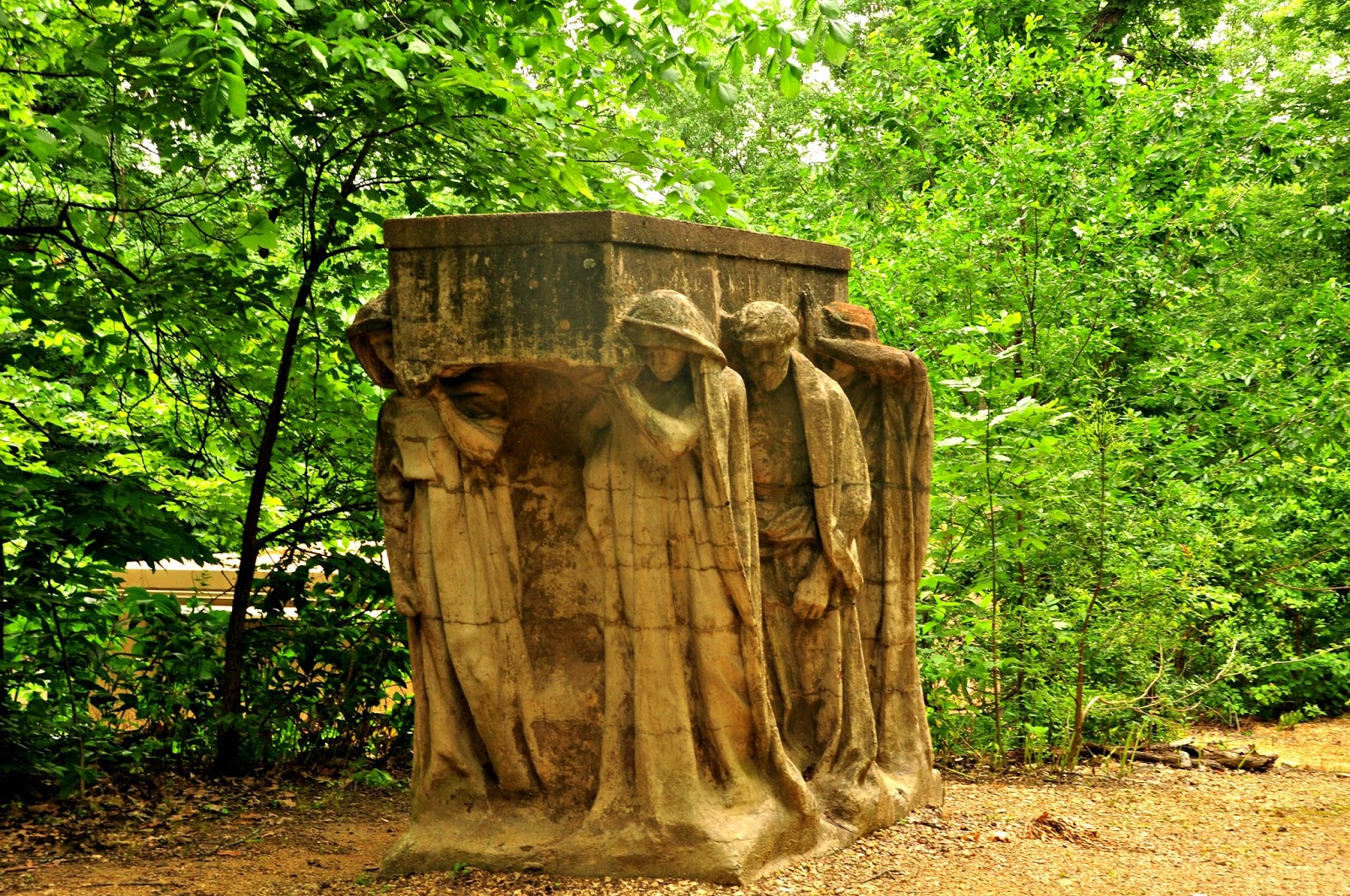
One of the most intriguing pieces is entitled the "Funeral Procession". It depicts a group of pallbearers carrying a casket as they march thru time. The story is that when the piece was commissioned in 1905 the six students who created it used their own likenesses for the faces of the figures cast. True or not I don't know but it's intriguing to think of a young artist ensuring he is immortalized in time. Nearby stands Taft's personal cottage. Done up in native field stone and red tile roofing, it abounds with period furnishings and lighting fixtures in the Arts and Crafts style that was so popular then. Nearby is the original dining hall with the bell that is still rung for every meal, showing
that nothing truly goes out of fashion.
So if you're ever in the mood for a short drive, consider visiting Oregon and discovering the many architectural treasures that await your visit.
Originally the colonists lived in tents and came from the Chicago Art institute and the University of Chicago's art department but after a formal charter was written they were permitted to build summer homes at the colony and often summered here to escape the sweltering heat of the big city. It flourished for many years and dozens of up and coming artists, sculptors, and talented men and women paid the colony a visit.
The property changed hands in 1951 when governor Adlai Stevenson transferred ownership of a portion of what had become Lowden state park to Northern Illinois university for what is now known as the Lorado Taft field campus. The campus is closed to the general public, but the day we were there Melanie from the office graciously allowed us access and gave us a tour of the remaining buildings and sculptural pieces still on site.
One of the most intriguing pieces is entitled the "Funeral Procession". It depicts a group of pallbearers carrying a casket as they march thru time. The story is that when the piece was commissioned in 1905 the six students who created it used their own likenesses for the faces of the figures cast. True or not I don't know but it's intriguing to think of a young artist ensuring he is immortalized in time. Nearby stands Taft's personal cottage. Done up in native field stone and red tile roofing, it abounds with period furnishings and lighting fixtures in the Arts and Crafts style that was so popular then. Nearby is the original dining hall with the bell that is still rung for every meal, showing
So if you're ever in the mood for a short drive, consider visiting Oregon and discovering the many architectural treasures that await your visit.
Monday, July 3, 2017
Ahead of its time
Last week I wrote about Dr. Ryan's round barn in Kewanee. This week I'd like to tell you about some of the innovations that made that barn a technological marvel, ahead of its time. It's central silo which could store 250 Tons of hay was filled via a steam engine that ran a conveyor belt up to the top of the silo. There's still a dark stain on the wall from the oil the conveyor used. Over head rails meant that no longer did workers have to trudge heavy loads of feed in wheelbarrows, it glided along effortlessly beside them.
Not only that but the rails could be changed, much like the tracks of a train could be switched so the train would go one way or the other, so too could the grain bins. And being Round meant that again like a train it could run along it's 'route' without stopping to make awkward turns and try to fit into nooks and crannies. The basement of the barn where the prize Black Angus where kept was filled with light, courtesy of a bank of spacious windows that ran the entire circumference of the building.
The round barn's demise as a working model came as farm machinery began to be powered, growing larger and larger until it wouldn't fit inside the narrow confines of the round interior. There are a dwindling supply of these round survivors left in the country and here in Illinois we are privileged to have not only a fine example of one, but also the largest one in the nation. The barn is open to the public the first and 3rd Saturday of every month now thru October. I strongly urge you to go check it out for yourself.
Not only that but the rails could be changed, much like the tracks of a train could be switched so the train would go one way or the other, so too could the grain bins. And being Round meant that again like a train it could run along it's 'route' without stopping to make awkward turns and try to fit into nooks and crannies. The basement of the barn where the prize Black Angus where kept was filled with light, courtesy of a bank of spacious windows that ran the entire circumference of the building.
The round barn's demise as a working model came as farm machinery began to be powered, growing larger and larger until it wouldn't fit inside the narrow confines of the round interior. There are a dwindling supply of these round survivors left in the country and here in Illinois we are privileged to have not only a fine example of one, but also the largest one in the nation. The barn is open to the public the first and 3rd Saturday of every month now thru October. I strongly urge you to go check it out for yourself.
Subscribe to:
Posts (Atom)